Green Key certified hotel receives Best New Sustainable Hotel award

Three establishments with the eco-label were nominated in the Sustainable Hotel category of the New Hotel Awards, held in Belgium, last week.

The Radisson Grand Place Collection Brussels won the Best New Sustainable Hotel award.

It is undeniable that the last two years have been particularly challenging for the hotel industry. While some hotels endured the difficult years by reinventing themselves and adopting new practices to attract guests, others were opening their doors and starting from zero amidst the COVID-19 pandemic. To recognise the effort and persistence of new hotels inaugurated in 2020 and 2021, the New Hotel Awards were created in Belgium.

The first edition of the awards show took place in the city of Antwerp, on March 14, where a panel of jury, consisting of industry experts, chose winners from seven categories: Best New Hotel Concept, Best New Hotel Restaurant, Best New Hotel Design, Best New Hotel Bar, Best Price Guarantee, Publieksprijs (Audience awards), and Best New Sustainable Hotel.

"The main purpose of this edition was to showcase new hotels and to give a boost after these unpleasant corona years. We can proudly say that the first edition was successful and that we discovered a lot of new gems. We are already looking forward to all the beautiful things that we will see in the next edition," explained the jury president Rachel Persoon, after the ceremony.

In the category that showcases leading establishments in the field of sustainability, three Green Key certified establishments were amongst the four nominees, including the Hotel Nhow Brussels Bloom, the Radisson Grand Place Collection Brussels, and the Mercure Antwerp City Centre. The Radisson Grand Place Collection Brussels, which was first certified by Green Key in 2010 and still holds a valid certification, won the Best New Sustainable Hotel award.

Green Key International congratulates the winner and also Nhow Brussels Bloom and Mercure Antwerp for their work towards achieving a more sustainable tourism industry.

Read more about the New Hotel Awards here.

Green Key launches series of biodiversity webinars

As part of the Foundation for Environmental Education’s strategy for the next decade, Green Key is hosting four webinars on the importance of biodiversity to the tourism industry.

Climate change, biodiversity loss and environmental pollution. These critical environmental threats are the focus of the Foundation for Environmental Education’s (FEE) strategy for the next decade. Named GAIA 20:30, the strategy encompasses several actions and campaigns which aim to bring more awareness about environmental problems while contributing to a more sustainable world.

In 2022, the GAIA 20:30 focuses on biodiversity loss through different actions: promoting sustainable management of the coastal zone, combating pollinator and insect loss, preserving existing and creating new natural areas, and finally raising awareness of efforts to remove invasive alien species.

The biodiversity campaign is running across all five FEE programmes through different actions and initiatives, including a biodiversity quiz and a course that will be available from March 21. Within the Green Key programme, a series of webinars are being held in collaboration with Blue Flag, focused on the importance of biodiversity to the tourism industry. The first introductory webinar on April 5 is already open for registration (here) and will address the following key questions:

- Why is biodiversity important to the tourism industry?
- How does tourism contribute to biodiversity loss?
- How can tourism contribute to the protection of biodiversity?

Our speakers Mr Nikos Petrou, Naturalist, Nature Photographer and Author, and Mr Arnau Teixidor-Costa, Programme Officer - Ecosystem Resilience & Spatial Planning at IUCN Med will reflect on these questions and provide practical examples related to the topic.

See below our schedule for the upcoming Biodiversity webinars:

1. The importance of biodiversity to the tourism industry (April 5)
2. Welcoming nature as your guest - biophilic design in the hotel industry (April 25)
3. My establishment in action - how to support biodiversity in the tourism industry (May 12)
4. Tourism - a force for good for biodiversity (end of May - date to be confirmed)

Sign up to the first webinar event here!

"The ecolabel has paid off" – The example of DGI Byen in Denmark

The ecolabel contributed to cost reduction of the hotel and conference venue and improved its environmental strategy, according to the DGI Byen CCO (Chief Commercial Officer).

DGI Byen CPH hotel and conference centre

DGI Byen hotel and conference centre

As one of the 21 hotels that received the Green Key certificate in 2021 in Denmark, the DGI Byen hotel and conference centre is already benefiting from its decision of becoming a greener establishment. That is the opinion of Jesper Bremholm, the CCO of DGI Byen, who participated in the last of four Energitrim workshops organised by Sustain in January 2022. The last Energitrim workshop focused mainly on the importance of the Green Key certificate for hospitality businesses and the necessary steps for obtaining the eco-label.

Reflecting on the first year of DGI Byen with the Green Key certificate, the hotel and conference venue CCO Jesper Bremholm acknowledged that the company is already experiencing the advantages of being certified by Green Key. DGI Byen´s CCO explained that the ecolabel has not only helped the company to improve its environmental standards but also allowed DGI Byen to sell more.

To Green Key International, Jesper Bremholm clarified: “The ecolabel has paid off and brought advantages to our business as more customers today are concerned about environmental sustainability and therefore requires the ecolabel when they book location for meetings, conferences and so on. Also, our hotel guests are concerned about environmental sustainability, and we believe that having the Green Key label gets our hotel to appear in more online searches. In the economic perspective, it means that we gain customers who would not have chosen DGI Byen if we did not have the Green Key label.”

Moreover, Jesper Bremholm considers that the environmental work initiated through the Green Key certificate has allowed the hotel to better include both guests and employees in this new green strategy.

Sustainable journey of a Green Key certified restaurant featured on CNN

The Michelin awarded restaurant Grič in Slovenia has been a Green Key certified establishment since 2021.

Grič is the Slovenian word for hill. ©Suzan Gabrijan

Located in the green village of Šentjošt, a few kilometres away from Ljubljana, the Grič restaurant has made it on the Slovenian gastronomy map since becoming a Michelin star awarded restaurant in September of 2021. Young chef Luka Košir’s cuisine has been praised in the last couple of years due to his choice of local and seasonal products, some of which are produced by Grič’s team at their own farm.

Sustainability has been part of the Slovenian chef’s motto even before joining the Michelin starlight sky. In August 2021, one month before being featured in the restaurant’s prestigious red-coloured guide, Grič received its first Green Key certification, solidifying its commitment towards a greener and more sustainable hospitality industry. To become a Green Key certified establishment, Grič’s practices were assessed against a rigorous set of standards, requiring restaurants to increase the share of organic, eco or fair-trade labelled products yearly, for example. On the restaurant’s sustainable actions, Luka Košir said to the Michelin Guide: “We are 80% self-supporting with vegetables, 50% with fruits, and we also grow mushrooms. Foraging is an everyday task even in wintertime and is a big part of the restaurant's identity. We have a zero-waste policy when it comes to garden produce; we use the hard parts of the vegetables for compost and some vegetables and fruits as an extra treat for our animals. We have the first certified ecological duck farm”.

Slovenian Luka Košir is the current chef of the restaurant. ©Suzan Gabrijan

Grič has its own duck farm. ©Suzan Gabrijan

More recently, Grič’s sustainable efforts have also caught the attention of CNN, which featured the Green Key certified restaurant on their website. In the article, journalist Megan Alldrige describes the chef’s work as “blazing a trail for a more sustainable restaurant industry”. Moreover, the CNN story highlights how the surrounding forests and hills of Slovenia inspire the process of creating a dish, from the gardens to Grič’s table.

Read more about this Green Key’s certified restaurant here.

First Hilton Hotel in England to receive Green Key certificate

The Hilton Garden Inn London Heathrow has become one of the three hotels in the airport vicinity to hold the Green Key certification.

Representatives from Keep Britain Tidy presented Hilton Garden Inn London Heathrow General Manager Richard Lee with the international Green Key Award last week.

Located near the Heathrow airport in London, the Hilton Garden Inn is joining the list of over 3,000 establishments across more than 60 countries that have the leading sustainability certification. Furthermore, the hotel is the first one from the Hilton chain in England to become a Green Key certified establishment.

To receive the certification, the Hilton Garden Inn was submitted to a rigorous assessment to verify that the establishment was complying with the Green Key standards. These standards, set by the Foundation for Environmental Education (FEE) and recognised by the Global Sustainable Tourism Council, cover areas such as staff involvement, guest information and sustainable management of energy, waste, water, cleaning and food and drinks.

On the choice of the Green Key certification for the Hilton Garden Inn, the General Manager of the hotel Richard Lee has said:

“Sustainability is a core part of our purpose, so Green Key fits perfectly alongside the Hilton Travel with Purpose programme and our owner’s commitment to operating sustainable buildings & businesses. Sustainable and purposeful travel are becoming ever more important to our guests so having a Green Key Award demonstrates our commitment and will give our guests the assurance that they are making a sustainable choice when they stay with us”.

As part of its sustainability strategy, the Hilton Garden Inn London Heathrow has recently implemented several initiatives to reduce the ecological footprint of operations. According to the environmental organisation Keep Britain Tidy, responsible for managing the Green Key programme in England, some of the initiatives from the Hilton hotel focused on:

• Installing solar panels which generate approximately 3% of the hotels’ annual energy use;

• Making use of cutting edge technologies such as the Granuldisk Dishwasher, which uses small pellets and UV light to clean pots, thereby lowering the overall water consumption in the pot wash area by on average 70%, compared to manual pot washing;

• Using EnozoPRO Spray Bottles which utilise tap water, diamond plates, and a small electrical charge to create Ozone Water, a safe and effective multipurpose cleaner, which replaces the need for synthetic chemicals that contribute to chemical pollution.

To learn more about the hotel, please visit their website

Green Key International congratulates the Hilton Garden Inn on its certification and is pleased to see the hotel among its certified establishments.

Green Key certified cottage goes green on fleet transportation

The 8-hectare Étangs du Francbois holiday estate, where the Green Key certified Le Chalet les Mélèzes is located, offers now two green transportation options to its guests.

The Étangs du Francbois holiday estate

Located in the beautiful valley of river Yves, in the region of Wallonia, Belgium, the Étangs du Francbois is a holiday home perfect for those searching for a peaceful vacation. With nature surrounding the 8-hectare property, there are plenty of outdoor activities to try at Étangs du Francbois, including following the hiking trails, swimming in the Yves River, fishing, wildlife watching or even boat rowing.

Owned by the couple Ann De Vlaminck and Patrick Meirlaen, the holiday site has several accommodation options, including a Green key certified cottage, Le Chalet les Mélèzes, since 2019. As part of their sustainability commitment, the Étangs du Francbois owners have recently upgraded their transportation fleet used in the property for more eco-friendly vehicles.

My wife and I are running a 20-acre [8-hectare] holiday estate with 3-holiday cottages and two unique camping spots. Transport on the estate is one of our concerns as a ‘green key’ certified company. In the past years, we realised it is not a good idea to have our customers parking their cars at their holiday cottage”, explains Patrick Meirlaen. According to the owner, the decision to remove guests’ cars from the central area of the property was motivated by two main factors: “First of all, it is not secure because they could block the road for firefighters. Moreover, it is not very nice for the superb views on the estate to have cars parked in several places in the gardens”.

The new green transportation options offered in Étangs du Francbois can be used during Le Chalet les Mélèzes guests’ arrival, departure, and stay. The first option is an electric all-purpose and all-terrain vehicle with a cargo container, ideal for transporting visitors’ luggage. Moreover, there are also wagon carts available to all guests during their entire stay. These carts have a load capacity of up to 300 kilograms, which can be ideal for transporting children inside the property, but also groceries.

Number of Green Key establishments increase by 20% in France

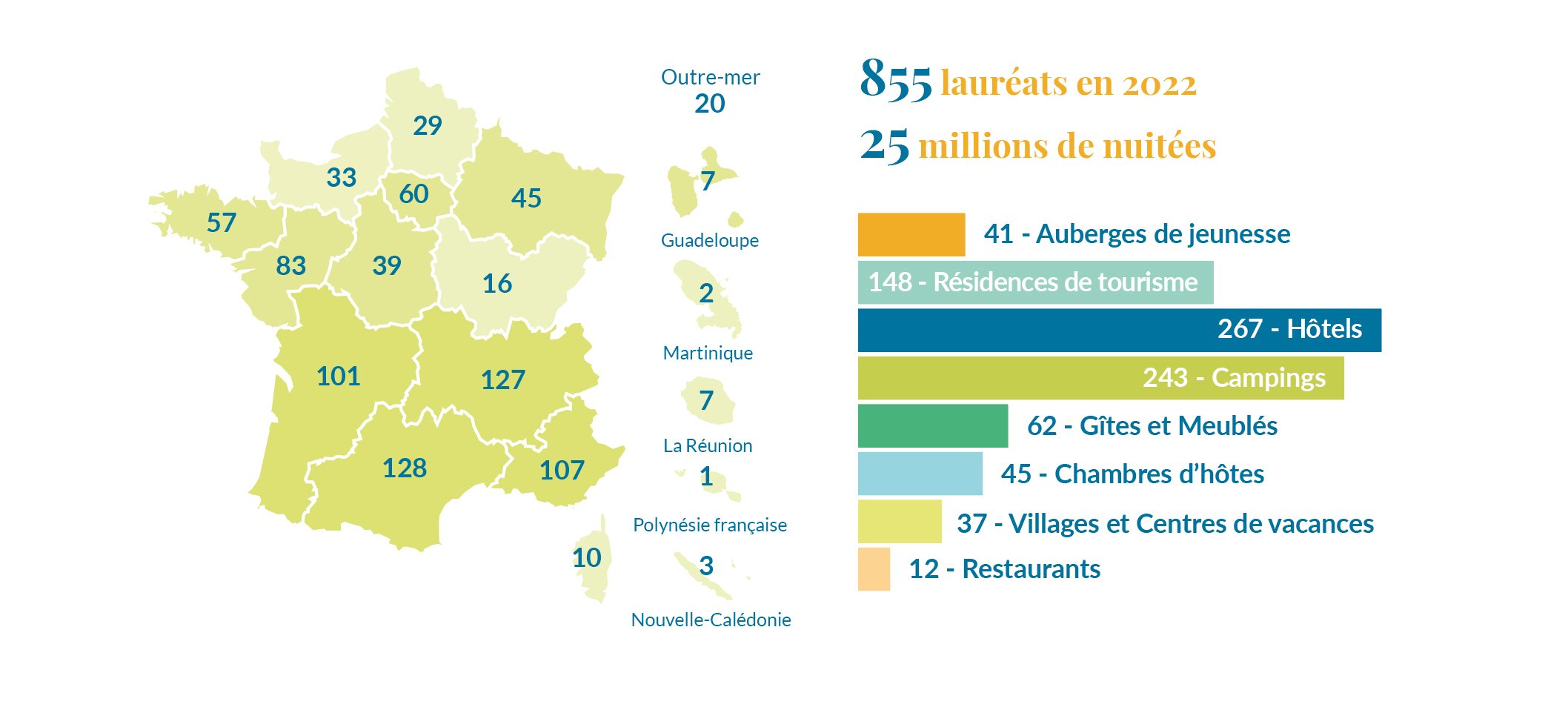
In 2022, there are 855 accommodations and restaurants with the Green Key certificate in France.

On 20 January 2022, the Green Key team in France has proudly announced an increase of 20% in the number of certified establishments in 2022. According to the French Green Key National Operator, Nathalie Bel Baussant, there are now 855 accommodations and restaurants certified in France (including overseas territories), representing 25 million guest nights and 20,000 employees.

The increase has been continuous in the past four years and has even accelerated during the COVID-19 crisis. It concerns all regions and all types of establishments: hotels, campsites, holiday parks, hostels, small accommodations and restaurants.

This trend can be explained by several reasons:

  • The national context encourages sustainable development: economy recovery plans after the COVID-19 crisis, ranking of hotels that including environmental actions, rising customer expectations;

  • The Green Key team in France has an active partnership approach: with chains and groups, but also territories, institutional actors and representatives of the tourism industry;

  • An increasing number of chains, territories and independent establishments consider sustainable development as a key success factor;

  • The Green Key team in France proposes an application process that includes advice and strong support tools to ease the implementation of criteria.

Green Key France awards for region

Greek tour operator to be the first to reduce environmental impact on excursions

The Greek company Avra Tours has signed an agreement with the Green Key National Operator in Greece to reduce the environmental footprint of its transports and excursions to the minimum.

Avra Tours has now a new green strategy, aligned with the Green Key sustainable standard. The company, which is the largest Greek inbound tour operator in the country, has entered an agreement with The Hellenic Society for the Protection of Nature, the body responsible for the Green Key programme management in Greece.

The collaboration agreement was officialised by Avra Tours CEO Ioannis L. Dimitriadis and the President of the Board of Directors of HSPN, Nikolaos G. Petrol, also Vice President of the Foundation for Environmental Education (FEE). In a joint statement, both parties manifested their commitment and hope on this agreement, aligning with UN goals. They also emphasised the importance of joining synergies to create short and long term results for the tourism industry.

Avra Tours is further compromising to become the first Greek tour operator with the smallest environmental footprint on excursions and transports as part of this partnership. To achieve this goal, the Greek operator will offset its carbon footprint through the FEE Global Forest Fund, helping plant trees and educating new generations to become more sustainable in the near future.

Additionally, Avra Tours will also have stricter criteria for partnerships by only working with organisations and destinations actively engaging in sustainability practices or strategies. The Greek tour operator aims to encourage the businesses it collaborates with to reduce its environmental impact.

Green Key featured in The Historic Traveller magazine

The Historic Hotels of Europe publication has dedicated a page to the eco-label certificate, highlighting the recent changes in the Green Key programme.

Historic Hotels of Europe that promotes an incredible collection of hotels, manors and palaces throughout Europe has now published the third issue of its Historic Traveller magazine, with a page dedicated to the Green Key programme. In the article, the Green Key’s International Director, Finn Bolding Thomsen, reflects on the impacts of the COVID-19 pandemic in the hospitality industry and Green Key’s role in supporting the certified hotels and other categories in the hospitality industry during these challenging latest years.

“During this uncertain time, we have supported our Green Key awarded establishments by showing flexibility in the certification process and by running campaigns that were tailored to the needs during the pandemic”, explains Finn Bolding Thomsen, adding that due to the recent worldwide events, the climate crisis is further becoming a top global concern.

The set of Green Key international standards for establishments is also highlighted in The Historic Traveller issue since the criteria have recently been strengthened to increasingly focus on the reduction of carbon emissions and pollution and the protection of biodiversity. Ultimately, the goal is to continue sharing the best practices of the certified establishments, as the Green Key International Director emphasises:

“Our ambition is to support our participating establishments through training, webinars, and other supporting tools […]. We also want to increase awareness of the guests visiting Green Key certified accommodation through information and involvement during the visit as well as promotion of the sustainability efforts through social media”.

Lastly, the Historic Traveller’s article on Green Key also addresses the intention of the eco-label organisation to join the Glasgow Declaration, which aims for a net-zero future by 2050.

More details on The Historic Hotels of Europe can be read here.