
The tourism sector in Brussels joins forces to strengthen and expand the Green Key programme in the capital of Belgium
In an event held at ‘The Hotel Brussels’ on 25 February 2019, GoodPlanet, Inter-Environnement Wallonie, visit.brussels and the Brussels Hotel Association announced that they are joining forces to further promote Green Key in Brussels
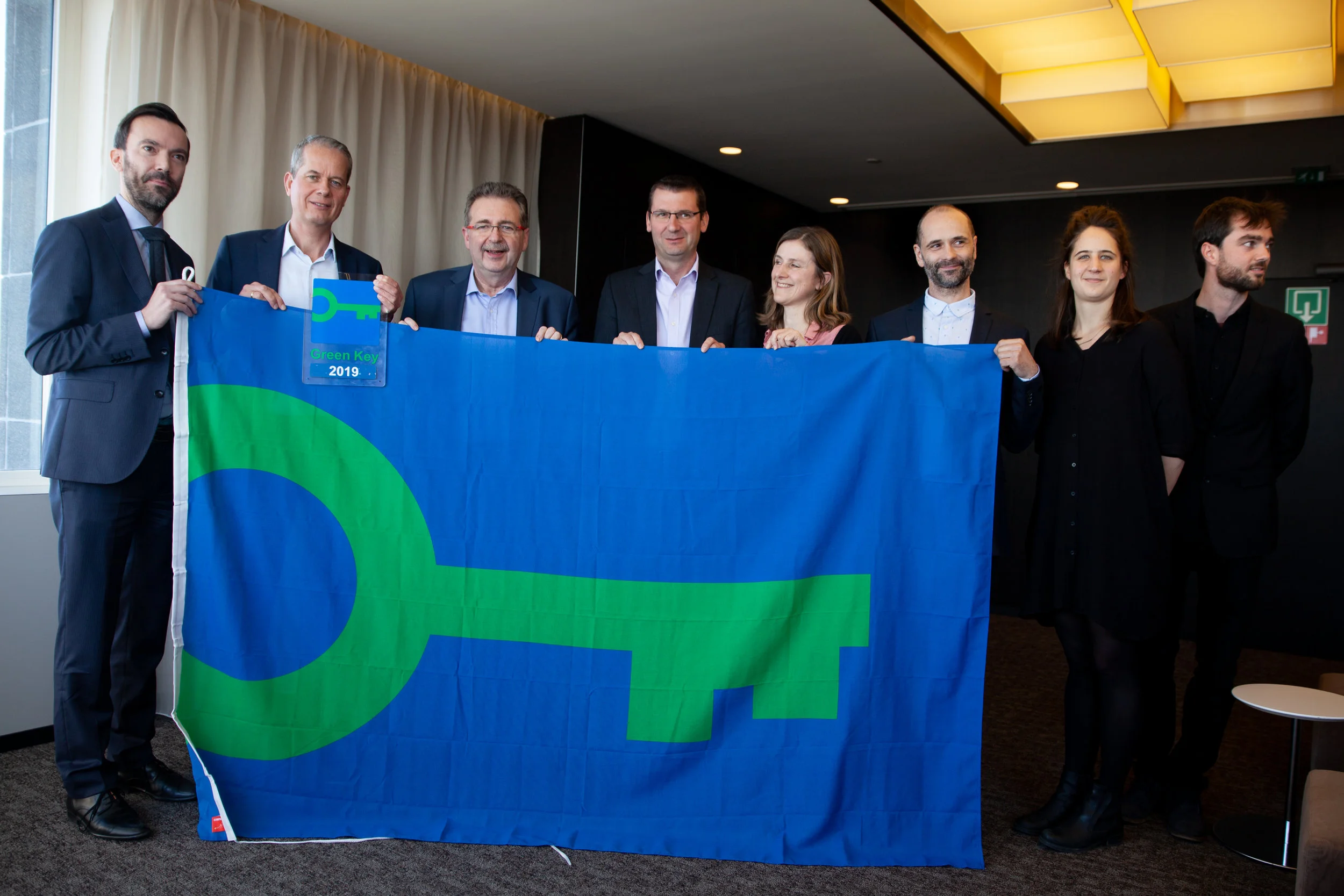
There are currently 239 Green Key locations in Belgium: 34 in Brussels, 69 in Wallonia and 136 in Flanders. Belgium is thereby ranked four on the list of countries with the highest number of Green Key awarded establishments.
Currently, 20% of all hotel rooms in Brussels stands out with a Green Key label, and a number of distinctive Brussels event venues and meeting places has also received the label, in collaboration with Brussels Special Venues.
To further grow the Green Key programme in Brussels, the various stakeholders have launched a new initiative to promote the label and support the Brussels candidates. In April and May, interested establishments can take part in workshops which will prepare them for acquiring the label. GoodPlanet and IEW have also developed a tool to help tourists easily find a sustainable accommodation in Belgium, so that tourists looking to travel sustainably will find Green Key locations to meet their expectations, through a search module and a map.
The new collaboration was presented in the presence of the Prime Minister of the Brussels-Capital Region government, Rudi Vervoort: “Brussels is an open city which welcomes everyone and in which the quality of life is above average. My task, as Prime Minister, is to implement a policy which benefits as many people as possible, while safeguarding the well-being of the residents of Brussels."

The cooperation was launched at an event at ‘The Hotel Brussels’, a hotel in Brussels that at the same time was awarded with the Green Key certificate for the first time. The Hotel is a first-class hotel with a breath-taking view across Brussels from its height of 94 metres. The 420 rooms are furnished in streamlined, contemporary design. The location, in the upper part of the city, is ideal and allows you to undertake many tourist activities in the surrounding area.
The Hotel Brussels has taken a lot of sustainability initiatives. The hotel, for instance, decided to partially produce its own electricity, through cogeneration, saving energy in the process. They took other sustainability measures too, and were awarded the Green Key label. The Hotel intends to go a step further than simply doing business more sustainable; they want to raise awareness in their guests about the subject too.
Greenview Releases Green Lodging Trends Report 2018
SINGAPORE—Greenview has released its 106-page Green Lodging Trends Report 2018. The Report is the lodging industry’s annual exercise to assess and catalyze green innovation, best practices, and awareness regarding the state of sustainability across hotels worldwide.
The Report which is published annually highlights and summarises responses to 115 survey questions in the categories of Energy Management, Waste Management, Water Conservation, Health & Wellness, Back of House, Communications, Staff Involvement, Community Involvement, and Climate Action & Certification. The Report is supported by Green Key.
Greenview received data for 4,544 hotels across 61 countries. Of the overall data set, 2,202 properties were classified as City/Urban Hotels, 814 as Suburban Hotels, 607 as Resorts, 296 as Small Metro/Town, 258 as Airport Hotels, 211 as Convention/Conference Centers, 66 as Bed & Breakfast (B&B) Hotels and 11 as Serviced Apartments (the remainder of the properties are unidentified). A total of 2,271 properties of the data set were in Asia-Pacific, 2,127 in the Americas, and 146 in Europe, the Middle East and Africa. In terms of service type, 2,564 (56 percent) properties were classified as full-service properties, and 1,954 (43 percent) were classified as limited service (the remainder <1 percent properties’ service type is unidentified).
The responses do not represent the full data set, as participants were not required to answer all questions. The full data set also includes integration from other sources to augment the missing regions and hotel types. Participants received an insightful Benchmarking Report with further peer analysis by location and market segmentation across all the best practices surveyed. One of the objectives of the Report is to establish a benchmark against which one can compare one’s own property from year to year—whether that is against one’s own progress or that of other similar properties. While impossible to tell the individual stories of thousands of properties, this Report includes examples of best practices in action throughout the world.
Best Practices Examples Highlighted
The Report includes examples of best practices as well as graphs that include results broken down by region and property type. The following are examples of just some of the highlights from the Report:
Eighty percent said more than 90 percent of their guestrooms have occupancy sensors.
A total of 82.7 percent have over 75 percent of their hotels’ interior space equipped with LED light bulbs, up from 2017 (70.1 percent) and 2016 (54 percent).
21.4 percent of hotels have on-site renewable energy.
32.5 percent have electric vehicle charging stations installed, an increase of 6 percent since last year.
53.1 percent place recycling bins in guestrooms, an increase since 2017 (43.8 percent) and 2016 (42.6 percent).
58.5 percent have bulk soap and shampoo dispensers in over 90 percent of their guestrooms. This practice is more prevalent in Asia Pacific (63.2 percent) than in EMEA (39.2 percent) and the Americas (23.2 percent).
69.7 percent have low-flow showerheads for over 90 percent of the guestrooms.
26.1 percent capture rainwater for property use.
72.4 percent target travelers who are concerned about health and wellness in their marketing.
41 percent offer portable air purifiers in guestrooms upon request or in designated rooms for guests with allergies or chemical sensitivities.
51.2 percent have a linen/towel reuse program in place that offers guests the option of opting out of housekeeping services altogether for one or more nights.
85.8 percent have a policy that requires procurement from local suppliers. This is an increase from 2017 (82 percent) and 2016 (74.4 percent).
42.5 percent grow food ingredients such as herbs or vegetables on-site.
55.3 percent have a space on their hotels’ website dedicated to sharing green practices. The adoption rate for this practice has increased since 2017 (51.4 percent) and 2016 (48.2 percent).
Globally, 70.6 percent have a green team or sustainability management team.
70.6 percent give employees the opportunity to volunteer time and services during regular working hours.
Globally, 8.9 percent purchase carbon offsets or renewable energy certificates.
Source: Green Lodging News
Landal GreenParks in Germany supports electric mobility
In six out of the ten Green Key awarded holiday parks from Landal GreenParks in Germany, electric vehicles take the staff from A to B without polluting the environment.

So called “Christiania Bikes” with electric motors are used for the housekeeping in two of the ten parks in Germany
Landal GreenParks is an organisation that administers 88 bungalow parks in nine countries. The main characteristic of Landal GreenParks is the open nature of the parks and its ambitious sustainability agenda. Each of the parks have their own initiatives to reduce their impact on the environment.
In Germany, six out of the ten parks are using electric vehicles for their everyday operations - especially in favour of the maintenance and housekeeping staff who has to cover quite a distance in the ample parks to get from one place to another.
All of the six parks have electric cars as well as electric carts for shorter distances.
In two of the six parks, the housekeeping staff uses electric cargo bikes as a quick and easy solution to transport all their equipment from one bungalow to another
Comwell Hotel Group: Environmental awareness generates commitment and retains employees
The Comwell Hotel Group, having a range of Green Key awarded hotels in Denmark, is experiencing greater commitment and loyalty among its employees as they have begun to work purposefully to transform their hotels into a greener and more sustainable hotel operation.
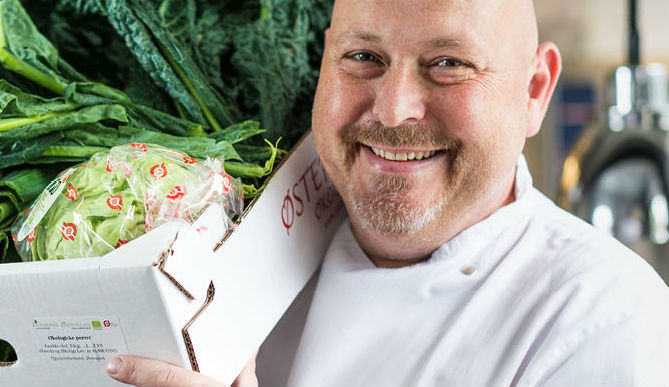
The Comwell Hotel Group began its green journey with Green Key in 2009. In the past two years, the hotel chain has strengthened the green transition, especially within the food area and staff efforts. The journey has resulted in more positive effects than predicted before the start.
The management has been surprised to see that the work with the green transition had a great effect on the employees’ job satisfaction and involvement in the company. Without having specified this as a motivation, Comwell might have found an important key to retaining employees; something that the entire industry might benefit from, and yet another important and strong argument for starting the green transition.
“When we receive job applications from potential employees, one of the arguments, for their wish to work with us, is our green profile. In our job satisfaction survey, the engagement score has also increased. Finally, the employees are very positive about recommending us as an Employer” says Mai-Britt Jensen about one very important side bonus to their green transition.
Green Key partners with green care PROFESSIONAL to promote sustainable solutions in washing and cleaning
To seek further carbon footprint reduction in the hospitality industry and to bring green innovation to its members, Green Key partnered with green care PROFESSIONAL in the field of sustainable cleaning and washing.

The “eco-brand with the frog” and Green Key want to put the resource savings potential of daily cleaning in rooms, laundry and kitchen into the focus and minds of Green Key establishments around the world.
green care PROFESSIONAL is one of the leading brand for sustainable professional cleaning products with EU Ecolabel and Cradle-to-Cradle® product certifications.
All products provide the highest eco-efficiency and performance and lower the environmental footprint by using 100% recycled packaging and regional organic raw materials. At get.wmprof.com a carbon savings tool with a selection of all green cleaning products shows how much plastics, crude oil and CO2 an establishment can save – just by chosing a circular designed product, where re-use, recycling, renewable energies and materials are in focus.
“In future, we hope that our concrete carbon savings certification is used by the Green Key establishments. The aim is to follow the idea of the Foundation for Environmental Education to educate owners and guests about the value of a true circular economy”, says Frank Vancraeyveld, CEO of Werner & Mertz Professional – the manufacturer behind the ecological brand.
“Not only is global pollution a problem and climate change anyone’s concern – it will also destroy the business foundation of touristic businesses around the world – nature – if not tackled now”, he adds.
The German based manufacturer of cleaning chemicals has a reputation of being a pioneer of Circular Economy for a long time – and translates that also into a sustainable success for its customers: Using 100% recycled plastics bottles and regional organic raw materials, 70 green care PROFESSIONAL products are eco-labelled and 40 Cradle-to-Cradle® certified – the leading international label for circular product design.
Frank Vancraeyveld: “With our approach we want to help customers of ours secure access in green markets and focus on real customer value. The whole world is talking about circular economy as a concept and is looking for solutions. We have these already, now we put them into the hands of the customers to make it their business advantage. We support and prepare businesses for a market shift towards a true circular economy, fueled by global developments, policy changes and regulatory demands.”
The carbon savings tool at get.wmprof.com is approved by external environmental auditors of INTECHNICA Cert GmbH (EMAS, ISO 50001, ISO 14001).
Find out more about sustainability in professional cleaning at wmprof.com
In many European countries, the Werner & Mertz group is also well known for its sustainable consumer brands “Frosch” and “Rainette”.
Radisson Hotel Group and Green Key renew and extend strategic partnership
After nine years of a successful partnership between Radisson Hotel Group and Green Key, the cooperation has been extended for another three years to include the hotel group’s hotels in Europe, Middle East and Africa, as well as the Asia-Pacific region.

Since 2010, Radisson Hotel Group and Green Key have enjoyed a fruitful collaboration, leading to more than 235 Green Key eco-labelled Radisson Hotel Group properties in Europe, Middle East and Africa (EMEA). This makes Green Key the preferred eco-label partner of Radisson Hotel Group, with around 80% of the group’s hotels in EMEA region being certified.
Green Key allows hotels to check their environmental practices against the detailed Green Key requirements and have confirmation of their performance through the on-site audit.
The success of the partnership in past years, and the value Green Key brings to Radisson Hotel Group hotels, has led to the renewal of the agreement for a coming three-year period. The cooperation has now been expanded, and Green Key will also be available to Radisson Hotels in the Asia-Pacific region (APAC).
Inge Huijbrechts, Global Senior Vice President Responsible Business and Safety & Security says: “We, at Radisson Hotel Group, are very engaged in sustainability initiatives. Through our internal Responsible Business Program and targets, hotels are driving their environmental and sustainability performance. We are proud that many of our hotels in the EMEA region have obtained external recognition of their actions through the Green Key eco-label. Now, we are looking forward to expand our partnership with Green Key to our growing portfolio of hotels in the Asia-Pacific region.”
Finn Bolding Thomsen, Green Key International Director, says: “We have enjoyed a great partnership with the Radisson Hotel Group for almost ten years in the EMEA region, and we are looking forward to supporting them in increasing the number of eco-labelled hotels, including those in the Asia-Pacific region.”
###
ABOUT RADISSON HOTEL GROUP
Radisson Hotel Group™ is one of the world's largest hotel groups with eight distinctive hotel brands, and more than 1,400 hotels in operation and under development around the world. The Radisson Hotel Group portfolio includes Radisson Collection™, Radisson Blu®, Radisson®, Radisson RED®, Park Plaza®, Park Inn® by Radisson, Country Inn & Suites® by Radisson and prizeotel.
Radisson Rewards™ is a global rewards program that delivers unique and personalized ways to create memorable moments that matter to our guests. Radisson Rewards offer exceptional loyalty benefits for our guests, meeting planners, travel agents and business partners.
Radisson Meetings place people at the heart of everything we do and treat every meeting or event as more than just a date in the calendar. Designed around three key commitments – Personal, Professional and Memorable – delivered through bespoke services, Radisson Meetings create successful and unique experiences for our guests.
More than 95,000 team members work globally for the Radisson Hotel Group and at the hotels licensed to operate in its systems.
For more information, visit:
Or connect with us on:
LinkedIn: https://www.linkedin.com/company/radisson-hotel-group/
Instagram (Employees): https://www.instagram.com/radissonmoments/
Instagram (Hotels): https://www.instagram.com/radissonhotels/
Twitter (Corporate): https://twitter.com/radissongroup
Twitter (Hotels): https://twitter.com/radissonhotels
Facebook: https://www.facebook.com/radissonhotels
Helsinki Travel Fair 2019 with focus on sustainable travel
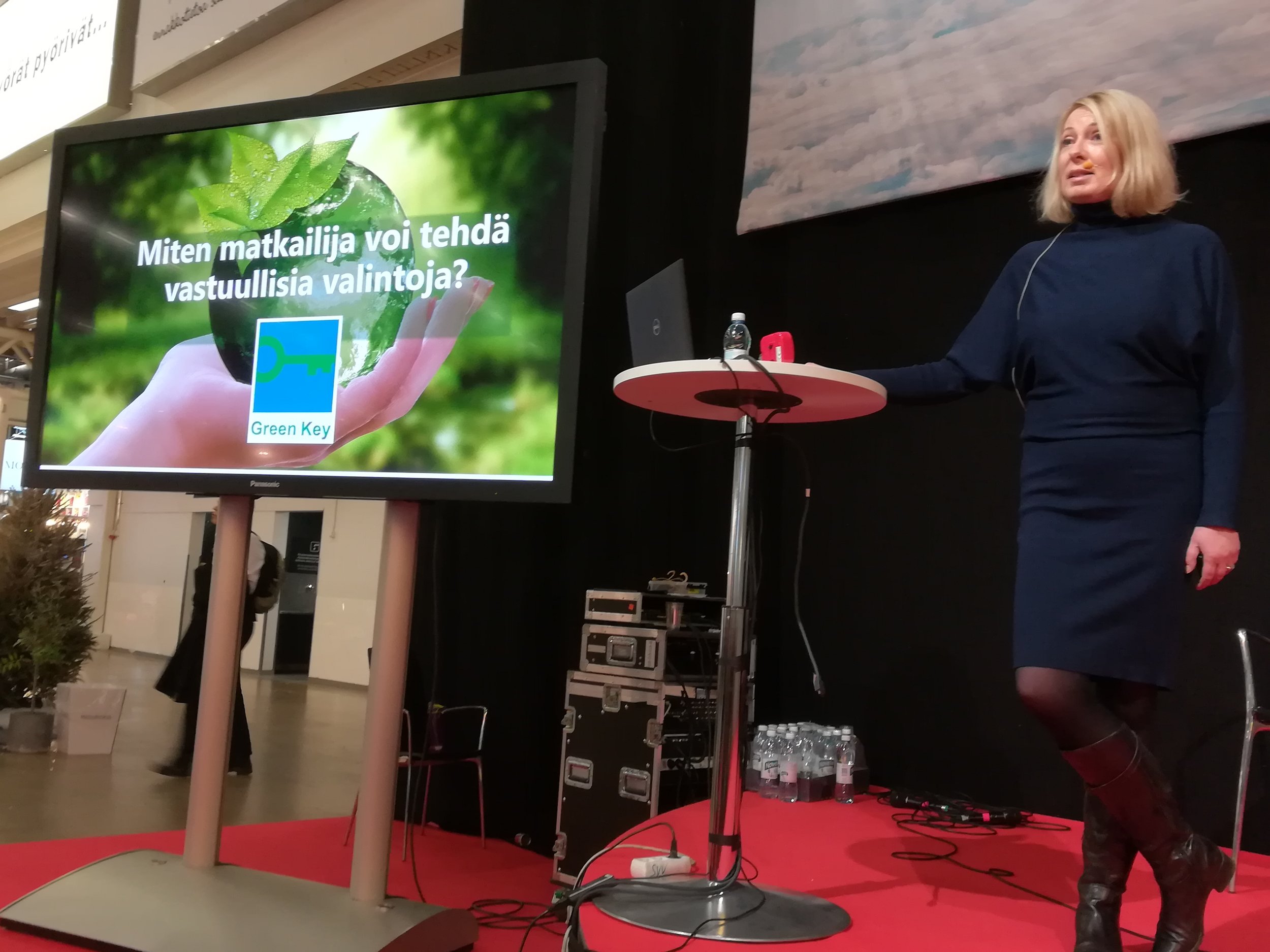
Green Key Finland actively participated in the Helsinki Travel Fair 2019, the largest annual travel fair in the Nordics, where the theme of the Fair in 2019 was sustainability in travel
The first two days of the four-day event was focused on travel professionals, and the last two days on consumers. During the first two days, travel industry actively discussed sustainability and presented best practices. Environmental sustainability was somewhat a focal issue, but also social, cultural and economic sustainability was included in many discussions.
Green Key Finland participated in a panel discussion by ICRT Finland, which is the official local partner for Professor Harold Goodwin’s International Centre for Responsible Tourism. The topic for the panel was Actions for Sustainability, and was thus a natural theme and of course the core for Green Key.

Marketta Viljasaari, Programme Director for Green Key Finland, highlighted the important every-day actions by Green Key awarded establishments in Finland. These examples included reduction in use of plastics, increasing use of LED-lights or taking out minibars from individual rooms and replacing them with fridges or lockable cold storage at reception as energy saving actions. The use of water-saving taps and showers, waste reduction and recycling and activities involving customers were also highlighted. Marketta Viljasaari stressed the importance of communicating environmental actions and raising awareness among staff and guests, and showed examples of these.
During the Helsinki Travel Fair, Green Key Finland also gave a presentation under the topic ‘Positive Power to Protect the Planet’ targeted for the consumer audience. Here, Marketta Viljasaari gave easy tips for all travellers how to make sustainable choices when planning a trip and selecting the destination and accommodation. Green Key awarded establishments were presented as examples of vast the variety of choices available for travellers, e.g. local transportation using bicycles, local food or visiting local nature sites.
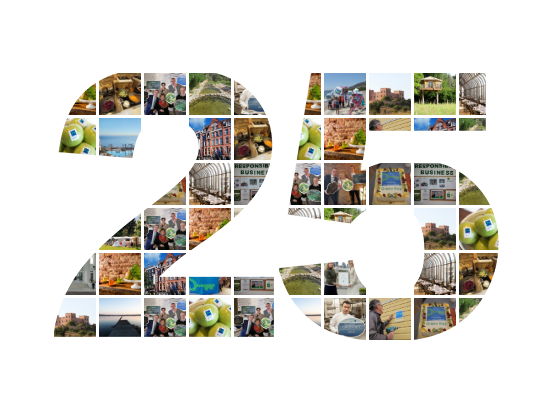
Green Key celebrates 25th anniversary
This year Green Key celebrates its 25th years anniversary. Initally launched in Denmark, today it has around 3,000 awarded establishments in almost 60 countries worldwide and is the global leading eco-label for hotels and other tourism facilities.
In 1994, the Green Key programme was invented by the Danish Hotel & Restaurant Association (HORESTA) together with other partners. The programme was inspired by the successful Blue Flag eco-label for beaches, marinas and boats.
The support from Danish authorities to Green Key as well as the increased focus on environmental issues globally assisted in making the Green Key programme known in Denmark.
From 1998, the founders started exporting the concept to other countries and France became the first country to introduce Green Key in 1998, and the programme quickly spread to other countries including Greenland, Sweden and Estonia.
Since 2002, Green Key the programme has been administered by the Foundation for Environmental Education (FEE) and its national member organisations, while the decisions regarding the development of the programme are taken by a Green Key International Steering Committee composed of the founders and FEE.
Through FEE’s membership network, Green Key was introduced in a range of countries. In 2007, an existing Dutch eco-label joined forces with Green Key, and since 2010, Green Key has been working closely together with international hotel chains: Radisson Hotel Group, Starwood Hotel Group (now part of Marriott International), Best Western and recently the NH Hotel Group.

Radisson Blu Hotel Astorija, Vilnius, Lithuania
Green Key was first started for hotels and a few other categories, but is today eligible for hotels & hostels, campsites & holiday parks, small accommodations, restaurants, conference centres and attractions. Detailed information about criteria as well as the standardised annual application, audit and award process is available on the Green Key website.
Finn Bolding Thomsen, International Director says: “Today, Green Key has around 3,000 awarded establishments in almost 60 countries worldwide making it the leading eco-label for hotels and other tourism facilities worldwide. Besides our continued focus on quality and quantity, the programme is developing tools to measure the effect of the programme and to support the applicant and awarded establishments in their sustainability work.”
Green Key is recognised by various UN organisations, Global Sustainable Tourism Council (has recognised the Green Key hotel & hostel criteria) and Green Key has partnered with various businesses, tour operators and a range of online booking and travel agencies.
Kirsten Munch Andersen, Political Director at HORESTA says: “Green Key is created in a joint venture between environmental organisations, the tourism industry and public institutions and it is based on a pragmatic and trustworthy Danish model. We have created a unique non-profit environmental certification which focuses on the collaboration between the involved establishments in a pace where the establishment itself sees the rationale in taking the lead.”
There is more information about the start of Green Key in Denmark in a publication developed by HORESTA called ‘From a Basement to the World – the story of Green Key’.
NH Hotel Group and Green Key announce a collaboration agreement
NH Hotel Group and Green Key announce a collaboration in which Green Key will support NH Hotel Group in achieving its ambitious sustainability goals

Sustainability is one of the main strategic values for NH Hotel Group, which prioritizes innovation in order to develop eco-efficient solutions. NH Hotel Group’s sustainability perspective is built on three principles: a) ‘We care for the people we host’, b) ‘We care for the destinations where our hotels are located’, and c) ‘We care for the planet we all live on’. The main focus of the group's sustainability work is with energy, water, responsible suppliers, carbon footprint and climate change.
Since 2007, the Group has been working on sustainability. starting with the Group’s first Strategic Sustainability Plan that year, the carbon footprint per room sold has been reduced by 72%, energy consumption by 34% and water consumption by 31%.
These results have been achieved thanks to many efficiency initiatives and procedures implemented in the Company’s hotels. Certifications such as Green Key help NH Hotel Group to improve further and represent a strong commitment with the environment.
“Sustainability and environmental performance are a key pillar for NH Hotel Group. Our hotels are engaged in sustainability and eco-innovative work, in fact, 140 NH properties have achieved a Green Key or another distinction for their activities. We are happy to continue the cooperation with Green Key through this global agreement,” said Ana Pinedo Lozano, Executive Environment & Sustainability – Operations.
During 2018, 6 new hotels of NH Hotel Group have been awarded with this certification reaching in total 46 hotels located in Belgium, France, Mexico, South Africa and The Netherlands. The 6 new hotels with the Green Key certification are: NH Brussels Bloom and NH Brussels EU Berlaymont in Brussels (Belgium); NH Centro Histórico in Mexico City and NH Collection Guadalajara Providencia, in Guadalajara (Mexico); NH The Lord Charles in Cape Town (South Africa); NH Collection Eindhoven Centre in Eindhoven (The Netherlands).
“We are proud to be an official cooperation partner to NH Hotel Group. Today, 46 NH hotels in the Netherlands, Belgium, France, Mexico and South Africa have already achieved Green Key, and other hotels are working towards meeting the Green Key requirements. Through our support, we are looking forward to inspire the NH hotels to continue upgrading their sustainability performance. Any NH hotels interested in pursuing Green Key is welcome to contact us for more information.” said Finn Bolding Thomsen, Green Key International Director.
About NH Hotel Group
NH Hotel Group is a consolidated trusted operator and one of the leading urban hotel companies in Europe´s business segment with a wide presence in America. The Company operates over 350 hotels in 28 countries under the brands NH Collection, premium upper-upscale hotels with iconic buildings located in the major capitals; NH Hotels, trustworthy upscale urban hotels offering the best value for money at the best locations; and nhow, unconventional and cosmopolitan design hotels with unique personalities inspired by the city vibe.
Since January 2019, NH Hotel Group is part of Minor Hotels, an international hotel owner, operator and investor based in Thailand. Joining their complimentary portfolios, NH and Minor operate a total of 7 brands spanning over 5 continents and make up one of the top 20 largest hotel platforms in the world.
About Green Key
Green Key is the world’s leading eco-label for hotels and other tourism facilities with around 3,000 awarded establishments in almost 60 countries around the world. The Green Key award is based on compliance with a strict set of criteria that include environmental management, environmental awareness raising and social responsibility. Green Key’s criteria for hotels and hostels are recognized by the Global Sustainable Tourism Council (GSTC). Green Key’s application, audit and award processes are also standardized and there is always a third-party verification of the award. Green Key is endorsed by various UN organizations, international hotel chains, hospitality industry related companies and online booking and travel agencies.