
Less visible to guests. Relevant to operational to impact.
In hospitality, environmental stewardship is often communicated through what guests can see.
For example, guest behaviours such as towel reuse, turning off lights, and declining stayover cleaning make choices visible. These actions do contribute, but they often unintentionally place the responsibility in the hands of the guest.
These measures may contribute to lower resource use, depending on how they are implemented, but the largest part of a hotel’s environmental impact is not decided by what guests occasionally choose.
Instead, impact is largely determined by what the hotel consistently does behind the scenes. Housekeeping is where one of the biggest opportunities remains under leveraged and under communicated.
Operational decisions that are not visible to guests, such as purchasing choices, dosing systems, training, laundry settings, and waste handling are other large contributors.
For this reason, Green Key International partners with organisations that deliver practical, measurable sustainability impact. One such partner is Diversey, supporting hotels in embedding measurable sustainability into housekeeping operations, from product choices and dosing precision to waste reduction and resource efficiency.
“Green housekeeping” is not only about cleaning less
Too often, sustainability in housekeeping is reduced to guest-facing options such as: Book a “Green Stay.” or Would you like to contribute to a more sustainable stay? Skip the daily cleaning of your room and you reduce the use of cleaning products, detergents, water, and energy.
It is a visible action and an easy message to communicate. And yes, it does contribute to reducing environmental impact. But it also subtly shifts the responsibility in communication towards the guest. And more importantly: It only addresses a fraction of the impact.
Communications should avoid implying that guest communication in room cleaning alone defines the environmental performance of housekeeping. It is more accurate to explain that such measures are only one part of a broader operational approach.
Where responsibility and improvement opportunity truly lies
The real impact of housekeeping is not decided by the moments guests opt out.
It is determined by the thousands of recurring operational decisions that hotels make every day.
Decisions about:
which products are purchased and used
how they are dosed and applied
which materials are selected and used
how often they are replaced
how water and energy are managed and how waste is reduced
how staff is (re)trained
These are not guest choices. They are hotel choices.
Skipping stayover cleaning saves resources.
But optimising the entire housekeeping system multiplies that impact significantly across more rooms and over time.
Examples of operational measures in room cleaning is reviewing introducing, entire housekeeping systems and (re)train staff using controlled dosing equipment and selecting products with concentrated formulations supported by relevant third-party certifications where applicable. From durable materials that last hundreds of wash cycles to low-temperature laundry processes that reduce energy use.
The effect of these measures depends on the products used, the baseline process, and how consistently the system is applied.
And together, they define the true environmental footprint of housekeeping.

From Ready-To-Use to concentrated formulations
By switching from Ready‑To‑Use products to high-concentrates used with controlled dosing systems, hotels reduce transport volumes, packaging waste, and the risk of over‑dosing.
This not only lowers the environmental footprint but also ensures consistent cleaning performance across teams.
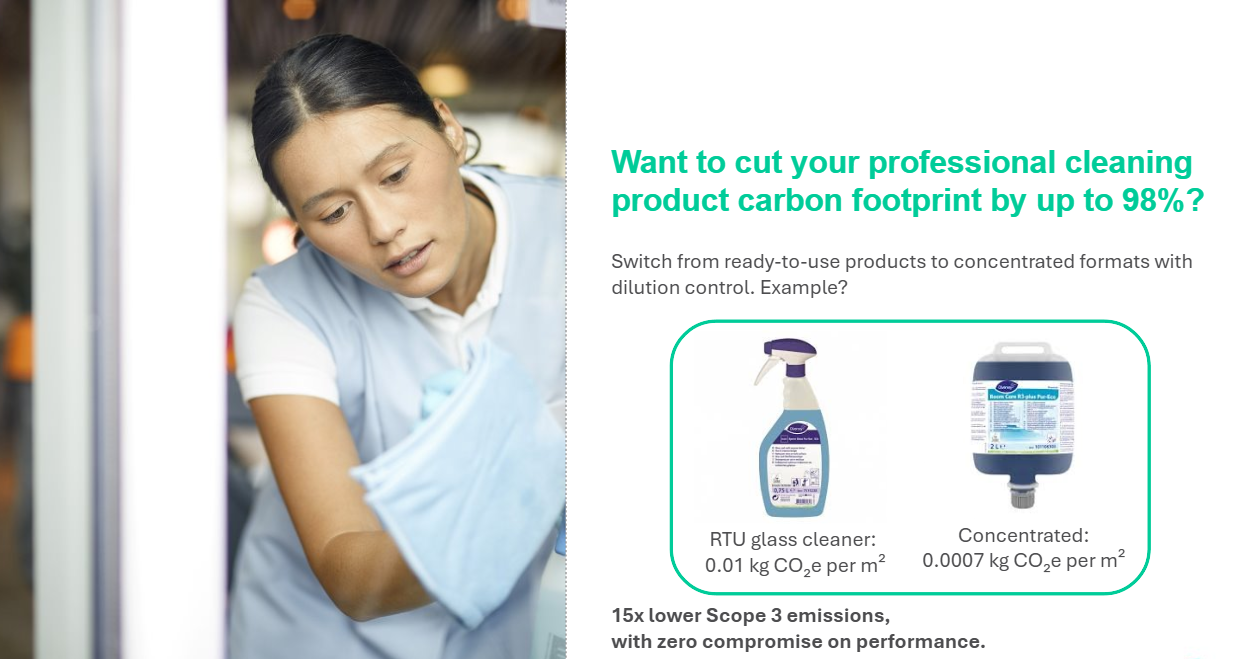
To illustrate this impact: switching from a ready-to-use glass cleaner to a highly concentrated alternative can reduce product-related emissions per square meter by up to 90%. The primary driver is eliminating the transport of water already added to conventional products: concentrates are shipped with only the active ingredients and are diluted with water on-site when needed. This reduces transport weight, packaging requirements, and associated emissions. None of these gains depend on guest participation but is designed into the system.
An untapped opportunity in communication
What we see across the industry is not always a lack of action. It is a gap in how this action is communicated clearly. Hotels tend to communicate what is easy to explain: what the guest can decide. But there is far greater value in explaining the operational measures the hotel has implemented and the scope of those measures.
Because this is where credibility is built. This is where trust grows. This is where sustainability shifts from a request to the guest to a commitment by the hotel.
From guest choice to clearer explanation
The next step for a more compliant approach in hospitality is not to stop engaging guests, but to rebalance the messaging: from "Help us reduce our impact" to "Here are the housekeeping measures we use to reduce resource use"; inviting guests to participate in a system already designed to perform. Green housekeeping is an operational discipline, and it should be communicated as such. Not as a broad, unsupported environmental promise, but as a set of concrete, evidenced practices: staff training, dosing controls, laundry settings, waste reduction, and recognised certifications where applicable.
This distinction is also becoming a legal requirement. From 27 September 2026, the EU's Empowering Consumers for the Green Transition Directive (ECD) will require every environmental claim made to European consumers to be specific, substantiated, and independently verified. Because in the end, guests do not only want to participate in sustainability. They want to believe in it.