
Le Méridien Vienna focusing on locally produced food
To celebrate the partnership between Green Key and Starwood, Green Key International will publish a monthly feature of a Green Key awarded Starwood hotel. In August we showcase the Green Key awarded Le Méridien Hotel in Vienna which has been implementing various sustainability strategies, including the efforts on ensuring more food locally produced.
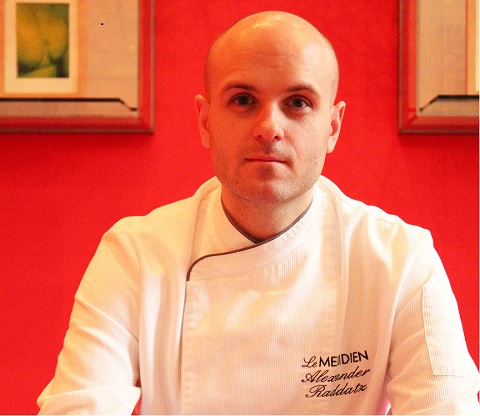
Several strategies and practices have been developed in order to make Le Méridien Hotel in Vienna “greener” in terms of environmental, social and economic sustainability. Through collaboration with their hotel owners, suppliers and business partners, the hotel actively works to reduce the environmental impact.
In order to minimize carbon dioxide emissions due to long journeys mainly locally produced food and drinks are purchased. That is also reflected in an investigation the hotel recently did. Around 62% of the food needed for preparation of the dishes is regionally produced and comes from Austria.
“The appreciation of the food quality in Austria is way different than in other countries” says Mr. Alexander Raddatz, Chef de Cuisine at Le Méridien Vienna who pays special attention where the products originate he serves his guests. “Why obtaining products from overseas, when I can get coequal regional products of probably better quality? Of course the price might be higher but taste and flavors are even better adherent with the conscience of having reduced the carbon footprint.”
A star that shines twice as bright
The Castellaras Restaurant, situated in a magnificent Provençal edifice in southern France, is the first Green Key restaurant to have obtained a Michelin star!

The acknowledgement of the famous guide comes as the icing on the cake for Hermance Carro and Quentin Joplet who have been promoting seasonal cooking and use of fresh local ingredients for years.
But Hermance and Quentin go far beyond the search for the perfect culinary match. They are equally dedicated to the quest for sustainable solutions in the kitchen as well as in the global management of their restaurant. The Castellaras was awarded the Green Key ecolabel in 2013 thanks to its many green practices: local sourcing and use of short supply chains, use of organic produce whenever possible, 100 % eco-friendly cleaning products, rainwater recovery, use of solar panels for water heating, recycling and waste recovery, use of naturals methods in the garden, etc.
Recently, an old greenhouse was transformed into a henhouse which became home for 15 new coworkers hired to help out with the recycling of green waste. There’s probably not need to tell you that the eggs are used in the kitchen by Quentin and his team.
We think everyone will agree that the Michelin star shines twice as bright at the Castellaras - once for the gastronomy and once for the sustainability!
For more information, please visit: http://www.restaurant-castellaras.com/
The Westin Paris-Vendôme saves bees
To celebrate the partnership between Green Key and Starwood, Green Key International will publish a monthly feature of a Green Key awarded Starwood hotel. In June we showcase The Westin Paris-Vendôme in France, a hotel with an impressive global environmental action plan.
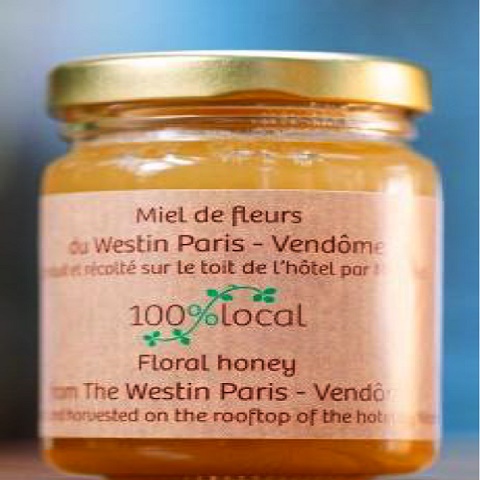
For several years now we’ve been hearing reports about the honeybees disappearing around the world. While the scientists try to better understand the causes behind this sad phenomenon, several Green Key awarded sites have already begun to act in order to help the honeybees overcome these difficulties.
Such is the example of The Westin Paris-Vendôme hotel that in 2012 placed a beehive on its roof. Thanks to this single beehive, 20kg of honey are harvested every year. Most of the honey is used in the hotel’s restaurant and spa while a smaller part is sold to the hotel’s clients. As taking care of honeybees demands knowledge and experience, the hotel decided to hand over the management and the monitoring of the beehive to a professional beekeeper.
The honeybees, gathering nectar in the famous Tuileries Gardens, are thriving in the city of Paris as the municipality decided years ago to reduce significantly the use of all chemicals in the maintenance of its green areas.
The beehive project fits into the global environmental action plan of The Westin Paris-Vendôme, a Green Key awarded site since 2011.
National park attractions in Wales awarded Green Key
Three popular visitor attractions run by the Pembrokeshire Coast National Park Authority have joined Green Key, the environmental accreditation promoting sustainable tourism.

Carew Castle and Tidal Mill, Castell Henllys Iron Age Village and Oriel y Parc Gallery and Visitor Centre have have joined over 2,300 attractions, hotels, B&Bs, campsites and restaurants in around 50 countries worldwide in securing the Green Key standard.
The Green Key is awarded to businesses that promote sustainable development and environmental awareness and also strive to reduce the environmental impact and consumption, in turn reducing costs.
National Park Authority Chairman Cllr Mike James said: “The Authority works hard to promote sustainability in all areas of its work, from supporting the coastal bus network to encouraging sustainable development through the planning process and the Sustainable Development Fund.
“The National Park Authorities are seen as exemplars in sustainable development and the Green Key is another way we can demonstrate how this can be beneficial to businesses as well as the environment.
“Examples of our commitment to sustainability can be seen at all three sites, in particular Oriel y Parc, where it was a key consideration in the design, appearance and materials used for construction.”
Green Key was successfully piloted in Pembrokeshire by Keep Wales Tidy with funding from the National Park Authority’s Sustainable Development Fund. There are now 17 businesses in Wales accredited by the Green Key Wales scheme.
Lesley Jones, Chief Executive of Keep Wales Tidy added: “Pembrokeshire Coast National Park Authority is at the forefront of sustainable tourism, so we are delighted that it has recognised the importance of Green Key, by both funding the pilot and gaining accreditation. We are absolutely delighted to welcome the Authority to Green Key.”
A 2012 Visit Wales survey found that travellers and tourists are increasingly aware of the importance of supporting socially responsible and environmentally sustainable businesses, with 72% of visitors in Wales rating environmental factors important in choosing their holiday destination.
Hospitality providers throughout Wales can apply for Green Key accreditation. For more information contact greenkey@keepwalestidy.org.uk or www.greenkey.org.uk.
The cooperation between Green Key and SGS is developing
In December 2014, Green Key entered an agreement with the world’s largest auditing company, SGS. Since then, the two parties have been busy developing the cooperation.

Besides mutual recognition, the agreement between SGS and Green Key involves the engagement of attracting additional hotels to Green Key in countries without a Green Key national operator.
SGS auditors in countries in South and East Asia (Indonesia, India, Thailand, Cambodia, Malaysia, Philippines, Vietnam, China/Hong Kong and Taiwan) and countries in Africa and Indian Ocean (Egypt, Mauritius, Kenya, Zambia and South Africa) have received training in the Green Key criteria and audit procedure.
SGS is already conducting other types of audits in many hotels, and the company will now be able to conduct the Green Key audit to the hotels expressing interest in Green Key. Green Key International will be in charge of the management of the Green Key programme in countries without a national operator, while SGS will be doing the audits for Green Key.
The cooperation has already led to interest from a number of hotels in South/East Asia and Africa/Indian Ocean, but hotels in other countries without a national operator can also now directly contact Green Key International with the interest to join Green Key.
The cooperation between Green Key and SGS is also developing in some countries with a Green Key national operator. In Bulgaria, Green Key and SGS has signed a mutual agreement, where SGS will attract hotels to Green Key and conduct audits on behalf of Green Key in Bulgaria.
If you are a hotel or other tourism facility wishing to join Green Key, please contact Finn Bolding Thomsen (mailto:finn@fee.global) at Green Key International.
You are also welcome to contact SGS national affiliates in South & East Asia and Africa & Indian Ocean:
Indonesia: David Situmorang (david.situmorang@sgs.com)
India: Arup Jana (arup.jana@sgs.com)
Thailand and Cambodia: Wansongkran Naktongtip (wansongkran.naktongtip@sgs.com)
Malaysia: Amy Yip (amy.yip@sgs.com)
Philippines: Emily Pascua (emily.pascua@sgs.com)
Vietnam: Kieu Hanh (hanh.nguyenkieu@sgs.com)
China: Aileen Ma (aileen.ma@sgs.com)
Hong Kong: Miranda Kwan (miranda.kwan@sgs.com) Taiwan: Eric Huang (eric-gt.huang@sgs.com)
Egypt: Ashraf Elzoheiry (ashraf.elzoheiry@sgs.com)
Mauritius and Indian Ocean: Daniel Julie (daniel.julie@sgs.com)
Kenya and Zambia: Solomon Onyango (solomon.onyango@sgs.com)
South Africa: Marina Sander (marina.sander@sgs.com)
Reputable or sustainable: what comes first?
How can hotels benefit from communicating their sustainable activities and why they need to be clear and proactive about doing so? Clare Garnham, Senior Account Director at Speed Communications sets out the case in an interesting article on Greenhotelier.com, a leading source of information on the sustainable and responsible agenda within the hotel industry.
Some Key Points:
- Communicating: responsible business activity is about communicating responsibly. Many business travellers will actively look for an environmentally conscious hotel, some even willing to pay more for the experience, which is encouraging, but equally challenging.
- Sustainable practices need to be evident, recordable and – critically – transparent.
- Communicating sustainable practices can’t sit in isolation, a bolt-on, a bit of text in one area of the website; they need to be communicated from all parts and all people in the business.
There is no doubt that responsible business strategy will continue to take on an escalating role, as will communicating such activity. For hotels, the challenge is to think about what you want to be known for and what you want your responsible business plan to say about you and your people. Gaining clarity of this and greater confidence in your beliefs will support a braver, a more holistic and importantly, a long-term approach to responsible reputation building. And communicating your sustainability will undoubtedly lead to increased CSR activity across the board.
You can read the full article here
Green Key awarded Sheraton Tel Aviv in the forefront of water and energy savings
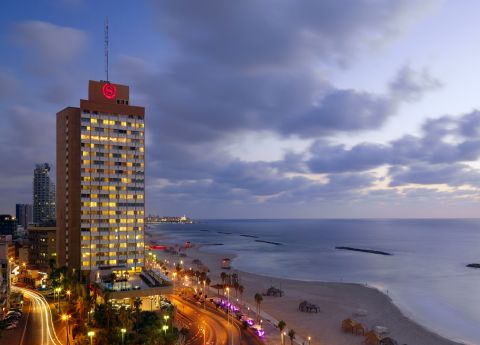
The Green Key awarded Sheraton Tel Aviv has been working in the last few years with the latest technologies available of environmental and sustainable development that are environment friendly and cost effective.
The Phoebus system is a groundbreaking technology company that combines new innovation of high-tech technology with old cooling technology. This technology is called Hydra Balance, and is a hybrid water system managed by smart cloud software.
The system is composed of Hydra Balance units, Hydra Monitoring & Control Module, and Hydra Monitoring & Control Cloud Software. The Hydra Balance unit is a designated water source heat pump, which pumps the thermal energy from the cold water A/C loop, and uses it to heat the water in a hot sanitary water loop. The Hydra Balance reduces energy costs not only by producing heat energy, but also by reducing the Air Conditioning electricity consumption. The system’s performance since the installation 15 months ago has shown a saving of 61% in energy and a reduction of 90% in diesel fuel consumption.
Another example is the SmarTap mixing valve. SmarTap E-Valve technology (patented digital shower system) enables online controlling and monitoring of shower water and inline pressure, that can save water usageand energy, while maintaining a luxurious shower experience.
Last but not least is the water treatment plant, where the hotel is able to control and monitor everything that goes into the sewage system with the help of bacteria and a strainer the separates the substance that goes to the sewage.
How to Reduce a Hotel's Energy Consumption
BookGreener connected, Green Key partner, is launching a series of free webinars on practical solutions to help make hotel operations more green. The next webinar focuses on energy consumption.
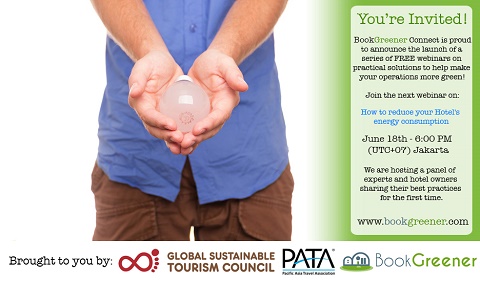
For a hotel, energy bills can quickly become a nightmare, but there are many things you can do. In average, energy saving programs can yield more than a 30% cut in your energy bill for the first year of efforts. To help you better understand what’s at stake and how to react efficiently, BookGreener has invited both an expert and a successful hotel manager.
The webinar includes expert's experience on energy and energy conservation measures, tips, best practices and hacks to reduce your energy bill and a real-life testimony of people who actually applied these tips in real life.
You are thus cordially invited to attend the next Webinar entitled: How to Reduce a Hotel's Energy Consumption.
Taking place on your computer on:
Thursday 18th June 2015, 6 PM in UTC+07. Click here to register.
But if you cannot make it, don't worry! Contact info@bookgreener.com and they will send you all the great tips and ideas from the event!
Camp Kovačine in Croatia, a true Green Key ambassador
Camp Kovačine is truly an amazing ambassador for Green Key in Croatia. Situated in a natural environment in the central part of Cres Island, in the Northwest of the Croatian side of the Adriatic Sea, guests can enjoy the clear sea or relax under one of the many pine and olive trees surrounding the camp site.

The management together with all staff make it their mission to take care of the desires and comfort of guests with a special accent on preserving natural values and the purity of the environment. Maintaining and improving the biodiversity of the surroundings is one of their main focus points.
All Green Key criteria’s are fulfilled and neatly documented. The campsite excels in waste management with their great organized waste separation system and energy management with an incredible energy saving policy. Camp Kovačine only uses "green" electricity. A national certificate with the "green" mark ensures guests that the electricity used throughout the complete campsite comes from renewable sources.
Green Key Croatia is extremely proud of their Green Key ambassador and hopes they will continue to cherish their well known environmental policy!